
Why does QuickBooks show negative inventory, and what is it doing to my margins?
The short answer
Negative inventory means you sold units the system had not yet received. QuickBooks still has to book a cost, so it estimates one, then silently rewrites that cost later when the purchase is finally entered. The correction lands in whatever period it likes, which is why gross margin moves on products where nothing about pricing or cost actually changed.
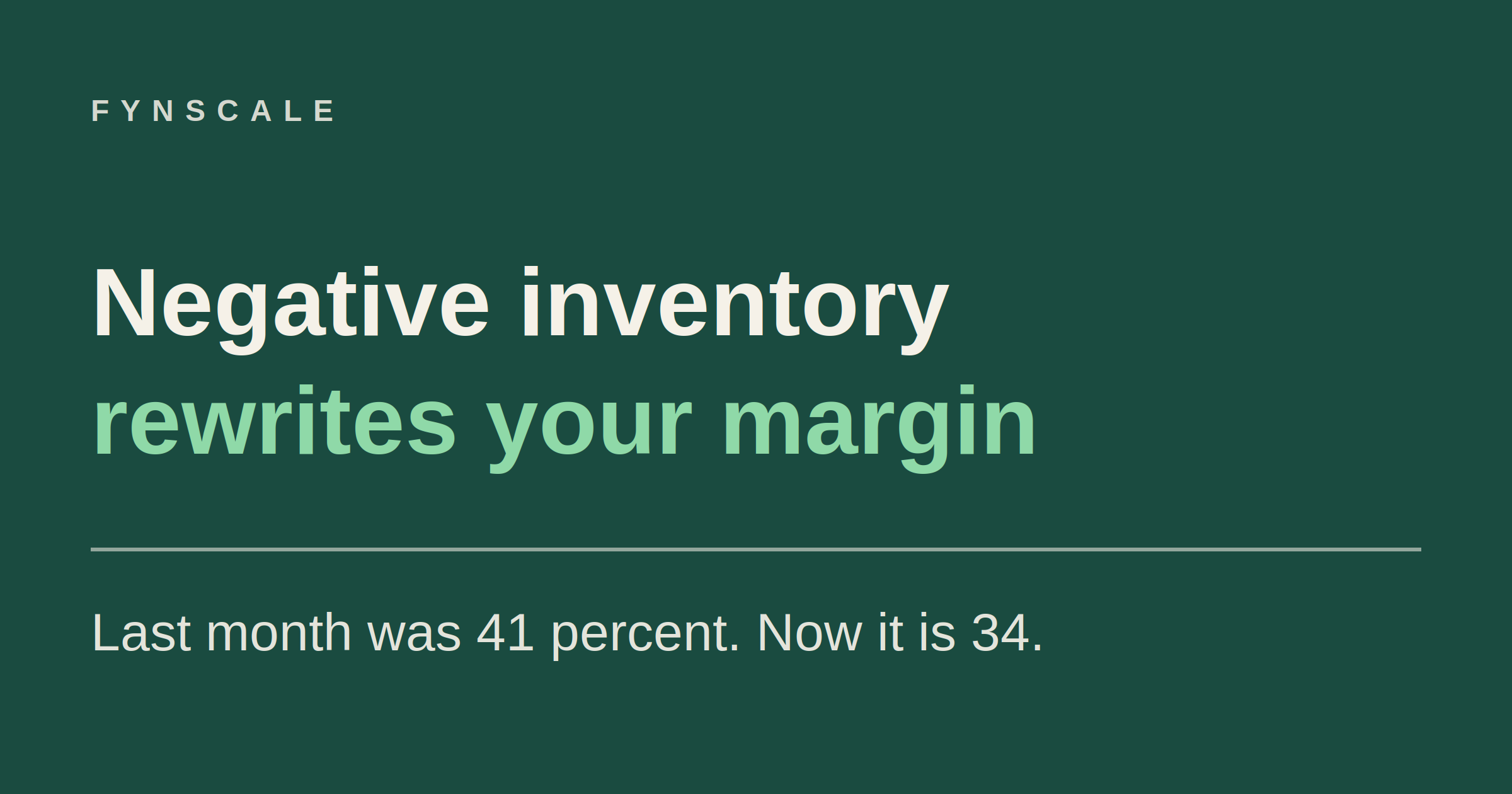
The system guesses a cost, then rewrites it later in a month you already closed.
By Stephen Ninesling, FynScale
Why does QuickBooks show negative inventory, and what is it doing to my margins?
Short answer. Negative inventory means you sold units the system had not yet received. QuickBooks still has to book a cost, so it estimates one, then silently rewrites that cost later when the purchase is finally entered. The correction lands in whatever period it likes, which is why gross margin moves on products where nothing about pricing or cost actually changed.
How does inventory go negative in the first place?
The system is doing arithmetic on quantities. It has no way to sell what it does not have, so when a sale is recorded against a zero balance, the count goes below zero and the software flags it.
Four situations produce it, and all four are operational rather than accounting mistakes.
Selling before receiving. The most common by far. A shipment arrives at the warehouse on Monday and product goes out the door Tuesday, but the purchase order is not received in the system until Friday when the vendor invoice shows up. For three days the system believes you sold something you never bought.
Dropship and third-party fulfillment. Goods never physically touch your building. The sale posts immediately because the customer was charged, while the supplier bill arrives days or weeks later.
Bundles and assemblies. Selling a kit consumes component quantities. If any component was not received, or if the build was never recorded, the whole assembly drives negative.
Unit of measure mismatches. You buy in cases and sell in units. If the conversion is set up wrong or inconsistently, quantities drift and eventually cross zero even though the physical count is fine.
Notice that none of these mean anyone did anything careless. They mean the paperwork trails the physical goods, which is normal in almost every business that moves product.
What does QuickBooks actually do when the count goes negative?
This is the part that matters, and it is not obvious from the interface.
QuickBooks Online uses FIFO. To record a sale it needs a cost for the units sold. When there are no units on hand, there is no cost layer to draw from, so it estimates using the most recent known cost for that item.
Then the purchase gets entered. Now the system knows the real cost, and it goes back and rewrites the original cost of goods sold entry to match.
That rewrite is the problem. It changes a transaction that was already recorded, potentially in a period you already closed and already reported on.
Follow one item. You sell 12,000 units on March 28. The system has no inventory, so it estimates cost at the last known figure of $14.00 per unit and books $168,000 to COGS. On April 6 the purchase is entered at an actual cost of $17.50, because the vendor raised prices. QuickBooks rewrites the March entry to $210,000.
March cost of goods sold just increased by $42,000 after March was closed. Nobody did anything. No entry was posted. The number simply changed.
What does this do to reported margin?
It makes it move for reasons unconnected to the business.
Take a brand doing roughly $40M a year, with a product selling at $32.00 and a true cost of $17.50, so a real margin of about 45 percent. Across a quarter where receiving consistently lagged sales by a week:
January shows the item at an estimated $14.00 cost, so margin reads 56 percent. February gets rewritten by January's late receipts and reads 38 percent. March, catching corrections from both prior months, reads 41 percent.
The real answer was 45 percent every month. The reported answers were 56, 38 and 41.
An operator watching that series concludes something is wrong with pricing, or with a supplier, or with the sales mix. They may change price. They may drop a product line. Every one of those decisions is being made on noise.
The damage scales with how much of your catalog runs negative. A handful of items is an annoyance. A quarter of your SKUs and margin by product becomes unusable, which means product-level decisions are being made on vibes while a report sits there implying precision.
What are the symptoms if I have not looked at the inventory report?
Four signs, and they show up in reports people actually read.
Gross margin that bounces month to month with no pricing or cost change. This is the loudest one. If margin moves three or four points a month and nobody changed anything, look here before looking anywhere else.
COGS entries dated inside closed periods. Run a transaction detail on cost of goods sold and sort by entry date versus transaction date. Entries created in April but dated in March are the rewrite happening in front of you.
Prior period financials that do not match what you reported. Pull the P&L for a month you closed three months ago and compare it to the version you sent out at the time. If they differ and nobody posted an adjusting entry, this is usually why.
Inventory valuation that will not tie to the general ledger. The inventory valuation summary and the balance sheet inventory account should agree. Negative quantities are one of the most common reasons they do not.
How do I find out how bad it is?
Run the negative item report. In QuickBooks Online it is under Reports, Inventory Valuation Detail, filtered to quantities below zero. Some versions surface it directly as a negative inventory warning.
Three things to read from it.
How many items, as a share of your catalog. Five out of 400 is operational noise. Ninety out of 400 means the receiving process is structurally behind and the fix is workflow, not accounting.
How negative, and how long. An item sitting at minus 12 for two days is timing. An item at minus 400 for two months means the purchase was never entered at all, which is a different and larger problem, because inventory and COGS are both wrong and have been for a while.
Whether the same items repeat. Recurring offenders point at a specific supplier, product line or person in the workflow. That is where a process fix has leverage.
How do you actually fix it?
Two layers, and the order matters.
Stop it happening. This is a receiving discipline problem, not a software problem.
Receive purchase orders in the system when goods physically arrive, not when the vendor invoice shows up. Those are different events and treating them as one is the root cause in most businesses. Receiving does not require an invoice, only the packing slip.
For dropship items, decide deliberately: either record the supplier bill at the same time as the sale, or take those items out of inventory tracking entirely and treat them as direct cost. Both are defensible. Leaving them in inventory with no receipt is not.
Check the negative quantity report weekly, not monthly. It takes two minutes and it catches problems while the paperwork is still findable.
Then correct what is there. For items currently negative, enter the missing receipts at actual cost. The system will recalculate, and cost of goods sold will move in the periods affected.
Once corrected, close the periods and lock them. Period locking is what prevents future receipts from silently rewriting history, and it is the single most valuable control here. It forces corrections into the current period where they are visible, instead of quietly changing a number you already reported to a lender.
If the affected periods are material and already went to a bank or an investor, that is a conversation about restated figures rather than a quiet fix. Better to raise it than have someone else find it.
What about landed cost, since it distorts the same number?
Worth covering alongside negative inventory, because the two are usually found together and they damage the same report.
Item cost should include everything required to get the unit onto your shelf: the purchase price, inbound freight, duty, tariffs, customs brokerage, and any inspection or repackaging. That total is landed cost, and it is the only cost that produces a true margin.
What happens in most small businesses is that the purchase price goes into inventory and everything else goes into an operating expense account. Freight lands in Shipping Expense. Duty lands in its own line or gets buried in Cost of Goods Sold as a lump.
The effect is a product that appears to cost $17.50 when it actually costs $21.80 landed. Gross margin per item reads about 45 percent when the real figure is closer to 32. Every product-level decision, which SKUs to reorder, what to discount, what to advertise, gets made on a number that is thirteen points optimistic.
It also interacts badly with negative inventory. When the system estimates a cost for a unit it never received, it estimates from a base that was already missing freight and duty. The two errors stack in the same direction.
The fix is to allocate inbound costs to the items on the receipt rather than expensing them separately. Most inventory systems support this, and where they do not, a periodic allocation applied at close is a reasonable substitute. The allocation method matters less than doing it consistently, since the goal is a comparable number month to month rather than perfect precision on any single unit.
Does this affect anything beyond margin reporting?
Yes, in two places that carry real consequences.
Tax. Cost of goods sold drives taxable income. If COGS was estimated low, income was overstated and tax was overpaid. If estimated high, the reverse, which is the worse direction. Either way the return was filed on numbers that later changed.
Lending and diligence. Inventory is often part of a borrowing base. A valuation that does not tie to the general ledger, or negative quantities on the detail report, is exactly what a lender's field exam looks for. It is also one of the first things a buyer tests, because it is fast to check and it says a great deal about whether operations and accounting are connected.
Common questions
Can I just turn off inventory tracking to make this stop? Only if you genuinely do not need product-level margin or inventory on the balance sheet. For most businesses selling physical goods, that trade is far worse than fixing the receiving process.
Why does QuickBooks let me sell items I do not have? Because blocking it would stop legitimate sales while paperwork catches up. The flexibility is deliberate. The silent retroactive cost adjustment is the part that causes trouble.
Does this happen in Xero or NetSuite too? Every system that uses a cost flow assumption faces the same problem. They differ in how loudly they warn you and whether they let you lock periods against retroactive change.
How do I stop receipts from rewriting closed months? Close and lock each period after you finish it. This is a setting, it takes a minute, and almost nobody in a small business turns it on.
Is a physical count the answer? A count fixes quantities at a point in time. It does not fix the process that drove them negative, so without a receiving change the problem returns within a quarter.
What if the purchase was never entered at all? Then inventory and COGS have both been wrong since the sale. Enter it at actual cost, then check whether the vendor was ever paid, because an unentered purchase sometimes means an unpaid bill.
How often should I reconcile inventory value to the general ledger? Monthly, as a named close step. It is the check that catches this and several other problems before they compound across a quarter.
Would average cost instead of FIFO solve this? It softens the swings because a single blended cost absorbs variation more smoothly, but it does not remove the retroactive adjustment. QuickBooks Online does not offer the choice regardless. The receiving discipline is still the fix.
FynScale is a professional services firm for accounting and finance. AI speed. Human judgment.