
The Hidden AI Token Margin Leak: How Unmetered Generative Features Silently Crush SaaS Unit Economics
The short answer
Unmetered generative AI features crush SaaS gross margins because heavy users consume $35 to $55+ in monthly model inference on flat $49 to $99 subscription tiers. Because token costs are frequently buried in general hosting OpEx rather than isolated as direct COGS, high-level P&Ls mask severe unit-level margin decay. Founders can fix this by attributing token consumption per tenant, separating inference COGS on the P&L, and transitioning to hybrid quota-plus-overage pricing.
Why unmetered AI features turn 80% gross margin SaaS into low-margin resellers, and the 3-step accounting framework to protect unit economics.
By Stephen Ninesling, FynScale
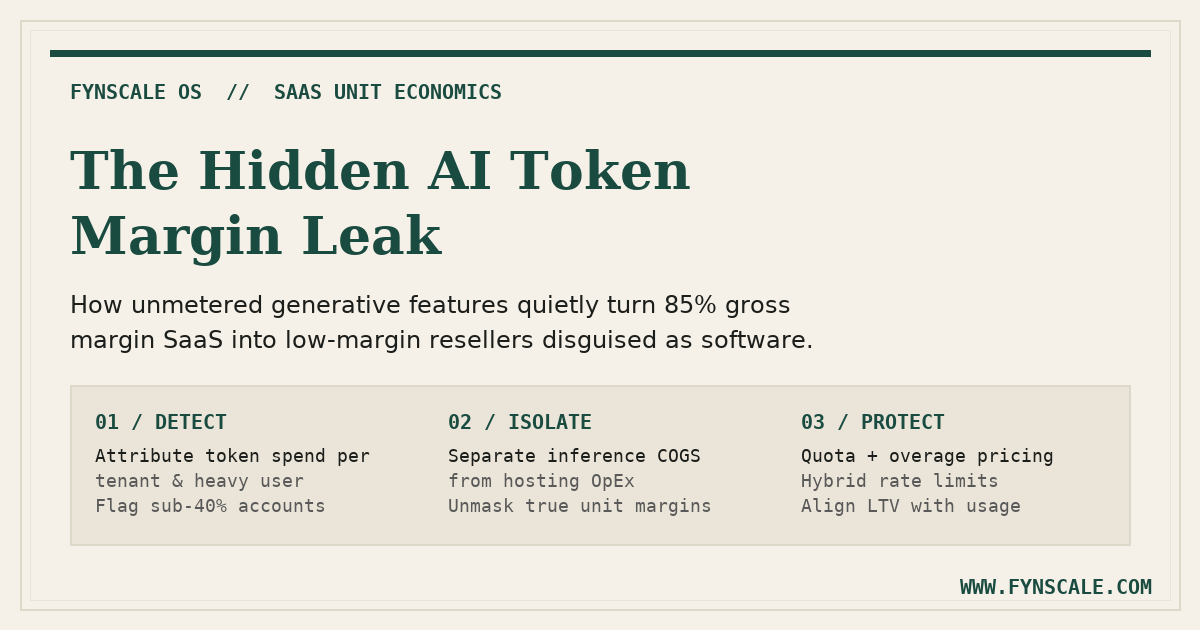
The Hidden AI Token Margin Leak: How Unmetered Generative Features Silently Crush SaaS Unit Economics
For the last decade, B2B SaaS economics followed a predictable script: build software once, host it on scalable cloud infrastructure, and enjoy 80% to 85% gross margins as top-line ARR expands.
Then generative AI arrived.
To stay competitive and drive adoption, founders across the $1M to $50M ARR tier rapidly integrated LLMs, automated agents, and intelligent copilots into their existing products. In most cases, these features were packaged directly into standard $49/month to $199/month flat-rate subscription tiers.
On the surface, everything looks healthy. MRR charts are trending up, feature adoption metrics are glowing, and customer feedback is positive.
Then the monthly model inference invoice lands from OpenAI, Anthropic, or AWS Bedrock.
Suddenly, a business that was modeled as an 80% gross margin software company is operating with unit economics closer to a 25% margin professional services reseller.
Here is how the margin leak happens, why traditional accounting fails to catch it, and the exact operating playbook to protect your gross margins.
- The Power-User Paradox
In traditional SaaS, power users are your most profitable cohort. They log in daily, embed your workflow across their team, and consume negligible incremental compute. Your cost to serve a heavy user is virtually identical to your cost to serve a casual user.
When you introduce unmetered generative AI features into a flat subscription tier, that dynamic inverts completely.
Consider a B2B productivity platform charging $79/user/month:
Base infrastructure cost: ~$3.50/user/month
Payment processing & transactional messaging: ~$2.50/user/month
Baseline Gross Margin: ~$73.00 (92.4%)
Now, introduce an unmetered AI document analysis feature.
A casual user running three prompts a week generates roughly $0.80 in monthly token costs. The gross margin holds strong.
A power user who connects the copilot to their daily enterprise workflow, uploads complex documents, and runs automated summaries can easily trigger 50 to 100 deep context calls per day. At current token pricing for reasoning-grade models, that single user generates $35 to $55 per month in direct API inference costs.
On a $79/month seat, your gross profit drops from $73 to less than $20.
The customer who loves your product the most and uses it every single day has quietly become your least profitable account. If that power user negotiates an enterprise discount, they are actively cash-flow negative.
- The Accounting Blind Spot: COGS vs. OpEx
Why do so many executive teams miss this leak until months after deployment?
The problem lies in how early-stage finance teams categorize model compute on the P&L.
When engineering teams first experiment with LLMs, the API keys are tied to a company credit card or lumped into general cloud infrastructure (AWS/GCP) alongside staging servers, internal tooling, and developer environments.
In traditional bookkeeping, cloud hosting is frequently treated as a blended line item or buried in general technology overhead within Operating Expenses (OpEx).
The Illusion
Because token spend is dispersed across general infrastructure, your high-level SaaS Gross Margin on the P&L appears pristine at 80%+. Meanwhile, your bottom-line EBITDA margin is bleeding out, and leadership assumes the burn is coming from marketing acquisition or headcount expansion.
The Reality
Model inference executed on behalf of an active customer is a direct Cost of Goods Sold (COGS).
Every token generated to deliver user value is directly tied to revenue delivery. Failing to isolate and attribute token costs directly to customer COGS distorts your gross margin, misleads board members and investors, and masks severe unit-level decay.
- The 3-Step Operator Playbook to Protect AI Margins
Fixing an AI margin leak does not mean stripping away intelligence or ruining the user experience. It requires treating compute as a consumable unit of value rather than a free utility.
Step 1: Instrument Tenant-Level Token Attribution
You cannot optimize what you do not measure at the account level.
Ensure engineering logs every model call with metadata tracking the tenant_id, user_id, and feature_id.
Tie prompt tokens and completion tokens back to your internal analytics.
Flag accounts whose rolling 30-day token cost exceeds 20% of their net subscription revenue.
Step 2: Separate Variable Inference from Core SaaS COGS
On your financial reporting and chart of accounts:
Break hosting into two distinct buckets: Core Platform Infrastructure (static) and Variable AI Model Inference (usage-dependent).
Calculate two gross margin figures monthly: Core SaaS Gross Margin and Blended AI Gross Margin.
Monitor the delta between these two numbers. If the gap widens by more than 500 basis points quarter-over-quarter without a corresponding expansion in ARPU, your packaging needs immediate restructuring.
Step 3: Shift from Flat-Rate to Hybrid Value Pricing
Flat-rate pricing on unmetered compute is unsustainable at scale. Transition toward modern pricing architectures:
Included Fair-Use Quotas: Bundle a baseline token/credit allotment into core tiers that comfortably satisfies 80% of normal users.
Overages & Token Packs: Allow power users to purchase additional compute packs or auto-bill overages at a 60%+ gross margin markup.
Model Routing: Route simple, high-frequency tasks to lighter, cheaper fine-tuned models (e.g., lightweight extraction) and reserve expensive frontier reasoning models exclusively for complex user requests.
The Bottom Line
AI features are one of the most powerful retention and expansion levers in modern software. But feature adoption without unit-level margin discipline is just subsidizing your customers' compute bills with your balance sheet.
Operators who build real-time financial visibility into their compute COGS can scale AI capabilities aggressively, protect their 80%+ gross margin profile, and build durable, highly profitable software businesses.